
Tutting at people who write ‘should of’ instead of ‘should have’. Despairing about new words such as ‘gifting’ or ‘twixmas’. Bemoaning younger generations who no longer use full stops. In my world, you’ll find no end of people sighing about the state of the English language. Often, I’m one of the crew.
But reading Why Q Needs U: A history of our letters and how we use them has reminded me I’m wrong. Language is a living, breathing thing that has always – and will always – evolve.
I’m going to take a fresh look at ‘incorrect’ spellings, the horror of new words and mangled grammar rules to suggest a different perspective.
Why incorrect spellings are the written word catching up with the spoken one
We instinctively think of writing and speech as being the same thing. They aren’t. Instead, each language has a shared understanding about how the words we write down are said out loud.
This shared understanding of the way spelling and pronunciation operate means that when a native English speaker sees the word ‘night’, we instinctively know you say it as ‘nite’. Similarly, ‘knee’ is ‘nee’.
Consider it the other way round too. We might say: “I ’ad forgotten my ’at”. We’d write that down without hesitation as “I had forgotten my hat.”
Different languages can have very different understandings too. To a native English speaker’s eyes, when Irish Gaelic is written down it can look impenetrable. For example, there’s a former Liverpool goalkeeper called Caoimhín Kelleher. You need an understanding of the relationship between written and spoken Irish Gaelic to know his first name is pronounced ‘kwee-veen’.
The reason we spell ‘night’and ‘knee’ in the way we do is because we did once pronounce the ‘gh’ and the ‘k’ sounds. It’s just our written language hasn’t kept up with that change. It’s therefore probably reasonable to assume that, eventually, we’ll write ‘nite’ and ‘nee’.
We’re perfectly comfortable with doing this. For example, ‘an apron’ used to be ‘a napron’. Based on that rationale, we probably shouldn’t despair of people who write ‘alot’ instead of ‘a lot’, ‘should of’ instead of ‘should have’ and so on – they’re simply leading the way.
Why new words should be embraced not shunned
Every year, the big dictionaries announce their words of the year. For 2025, they included ‘rage bait’, ‘parasocial’, ‘slop’ and ‘vibe coding’.
The announcements draw attention to the fact we invent new words all the time. Shakespeare alone is said to have coined more than 2,000 and we don’t shun him. The word ‘weekend’ is a compound word that didn’t properly enter the language with its current meaning until the late nineteenth century. Yet where would we be without it now?
We very often despair at new words entering our language. But they often fill a gap. ‘Gifting’ is one example I’ve seen lots of people complain about. I tend to agree with them, but also think it has a warmer, more loving connotation than the ‘giving’ you could replace it with. ‘Twixmas’ is another bugbear. But it’s a quick and easy way to refer to the time between Christmas and New Year that everyone instinctively understands, isn’t it?
The joy of language means if you don’t like a word, you can simply not use it. However, it’s important to recognise our lexicon evolves and always has done – otherwise we’d still be speaking in grunts.
Why grammar has always been subjective
It’s said younger generations are falling out of love with the full stop. We’re told they find it aggressive and it’s interpreted as someone being angry or trying to shut the conversation down.
To understand this, it’s worth considering where the full stop came from. It’s a third-century invention by Aristophanes of Byzantium. He used dots to indicate where readers should pause or take a breath. He used a high dot to mark the end of a thought (the modern full stop). A middle dot marked the need for a longer breath (essentially, a semi-colon) and a lower dot marked the need for a shorter breath (in other words, a comma).
When we think about the full stop falling out of favour, I’d suggest this is largely a quirk of messaging app writing. It’s common to have one micro-thought per message and to send multiple messages intended to be read as a whole. In this sense, the full stop is redundant (or overly aggressive) because the end of each message is performing that function.
It’s far from the first time this has happened.
Take commas as an example.
Look at nineteenth-century writing and you’ll likely notice two things. Firstly, the sentences are a lot longer. Secondly, they need a lot more commas to give you a chance of understanding them.
Here’s the first sentence of Charles Dickens’ A Tale of Two Cities (first published in 1859) as an example:
It was the best of times, it was the worst of times, it was the age of wisdom, it was the age of foolishness, it was the epoch of belief, it was the epoch of incredulity, it was the season of Light, it was the season of Darkness, it was the spring of hope, it was the winter of despair, we had everything before us, we had nothing before us, we were all going direct to Heaven, we were all going direct the other way – in short, the period was so far like the present period, that some of its noisiest authorities insisted on its being received, for good or for evil, in the superlative degree of comparison only.
It has 119 words and 17 commas. You almost never see sentences like this in modern writing. We tend to use shorter sentences and therefore need fewer commas. When you do see incredibly long sentences, they’re called out as being overly complex and too hard to understand (including by me).
Consider too how paragraphs are changing in the age of the internet. Big chunks of text are hard to read on screen, so paragraphs are becoming shorter – often, just a single line.
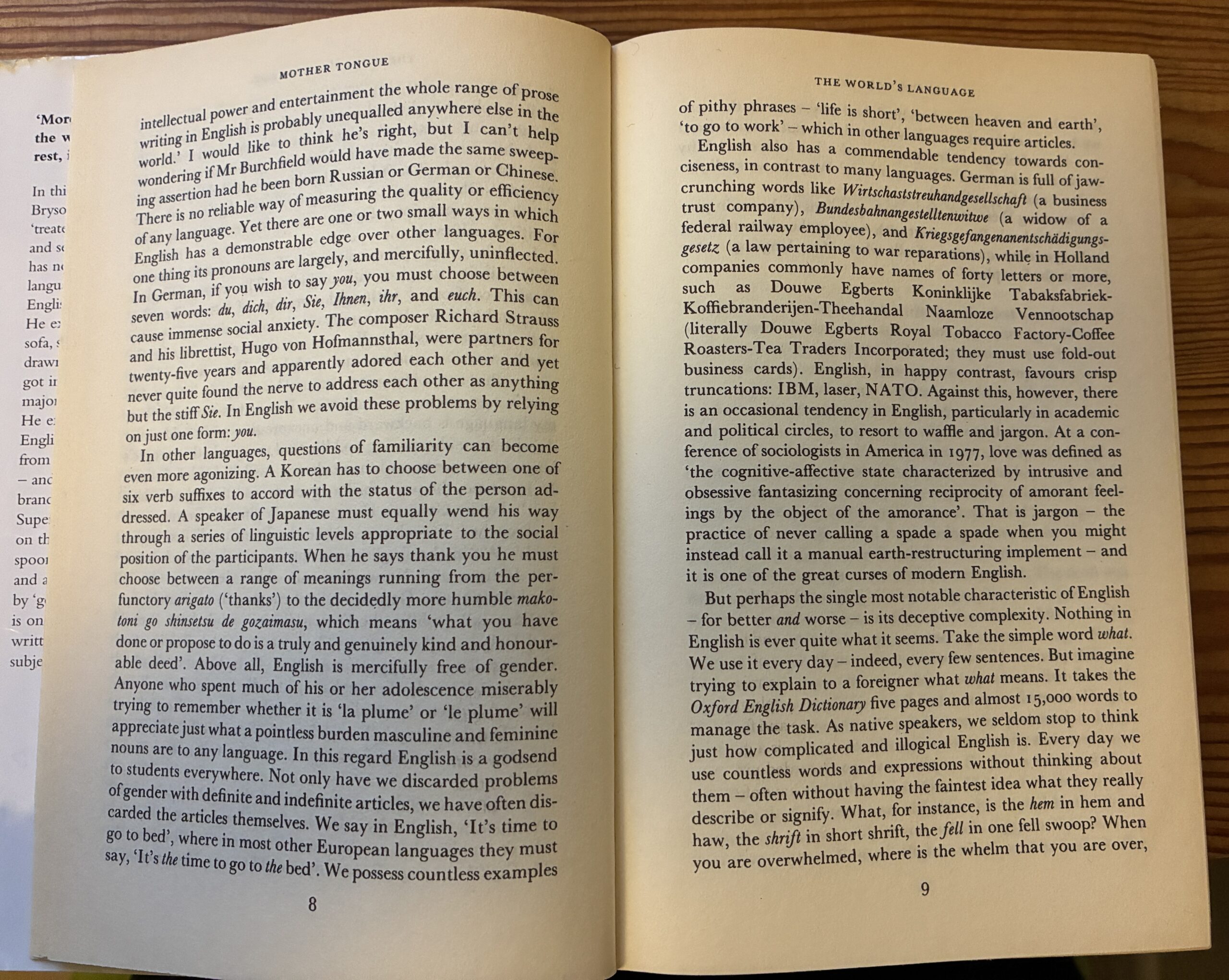
Yet in text written even just a few decades ago, paragraphs are much chunkier. Here’s a page from Mother Tongue by Bill Bryson as an example. It was first published in 1990 and the two pages have just four paragraphs between them. It looks dense to our modern eyes, don’t you think?
And remember that we used to write ’phone to indicate we knew it was short for telephone. Ditto ’til for until, ’80s for 1980s and so on. Yet very few people would think of using apostrophes to do this today.
In other words, full stops falling out of favour is far from the first time punctuation has evolved.
Upholder of traditional values or stick-in-the-mud?
For those of us who sigh over examples of ‘poor’ language, there’s a tendency to view language as being full of rules you shouldn’t break (and to judge people who do break them).
But I think there’s an alternative viewpoint I’m going to embrace it. It recognises that people aren’t breaking the rules, they’re doing what has always been done – evolving the language. If you’re keen to join me, I’d heartily recommend Why Q Needs U: A history of our letters and how we use them.
