
It’s a truism to say that copywriters like words and language. Of course we do. But I sometimes wonder whether we love them too much and whether we’re sometimes clever simply for the sake of being clever.
Take this example of a sign from a railway station. You may have seen it pop up on your social media feed.
This escalator is refusing to escalate. This has been escalated to the engineer who is on his way up (or down) to check it out.
Please use the escalators below the central dome, or the lifts adjacent to the Boar Lane entrance.
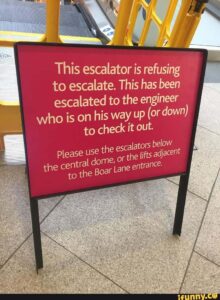
The first part is praised for its wit, its whimsicality, its cleverness. I’d agree. It makes me smile.
It’s also celebrated as a perfect example of how good copy can elevate even the most basic of wordy requirements. But personally, I don’t think we always have to elevate the most basic of wordy requirements. Sometimes I think words just need to be functional. They don’t need a copywriter being clever or showing off how creative they can be with words.
In a blog or your LinkedIn feed, the sign is amusing.
Now imagine walking past that sign on your way out of a rush hour railway station. In this scenario, I can see several problems with it.
- When you’re fighting your way out of a busy station, a broken escalator is annoying. The sign suddenly looks flippant or glib.
- It’s a long sign. If you want to read it, you’ll probably have to pause – thereby annoying all the other people fighting their way out of the station at the same time as you.
- It’s a long sign. You probably won’t pause to read it, so the cleverness is wasted.
- What if you struggle with reading or if English is your second language? How can you be sure that sign doesn’t say something important?
- (As a side note to this discussion, it’s also sexist – who says engineers have to be men?)
Personally, in this scenario, I think the second part is more effective. It’s much more prosaic than the first paragraph. But it also conveys the information it needs to convey very effectively. The only thing I’d suggest is changing ‘adjacent’ to ‘next’.
Sometimes, it’s right to be playful, revel in the joys of the English language, say ‘hey, look at me!’ with our words. Sometimes our role is to be straightforward, to use our skills to get facts out there simply and clearly. I think this sign is one of those times.
“This escalator isn’t working. We’re sorry. We’ll repair it as soon as we can. Please use the escalators below the central dome or the lifts next to the Boar Lane entrance.” is dull. It won’t make anyone smile. But it will do the job it needs to do.
